Sans Speakers is a generative, immersive sound installation piece using 100 recycled speakers.
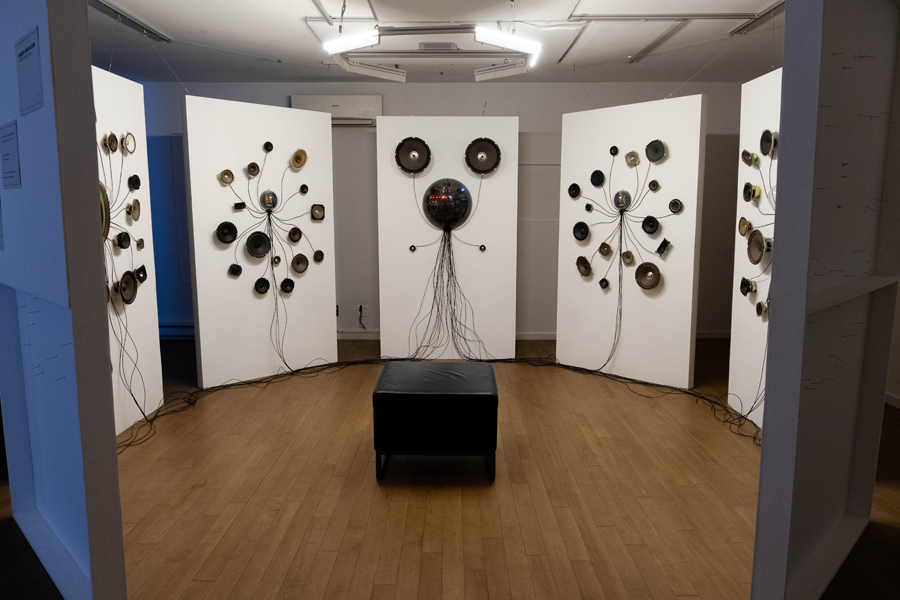
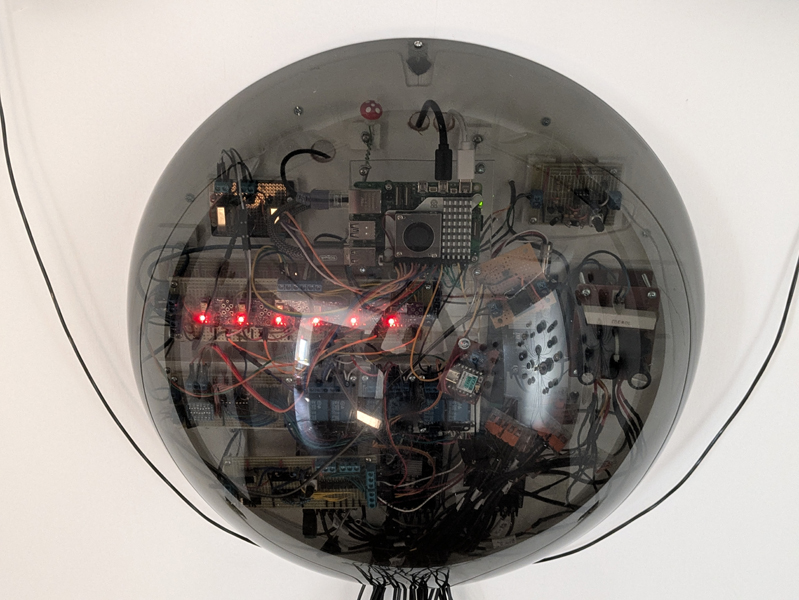
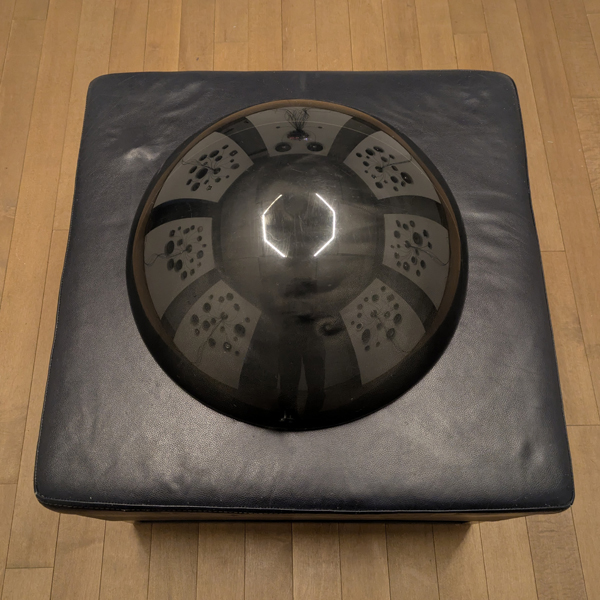
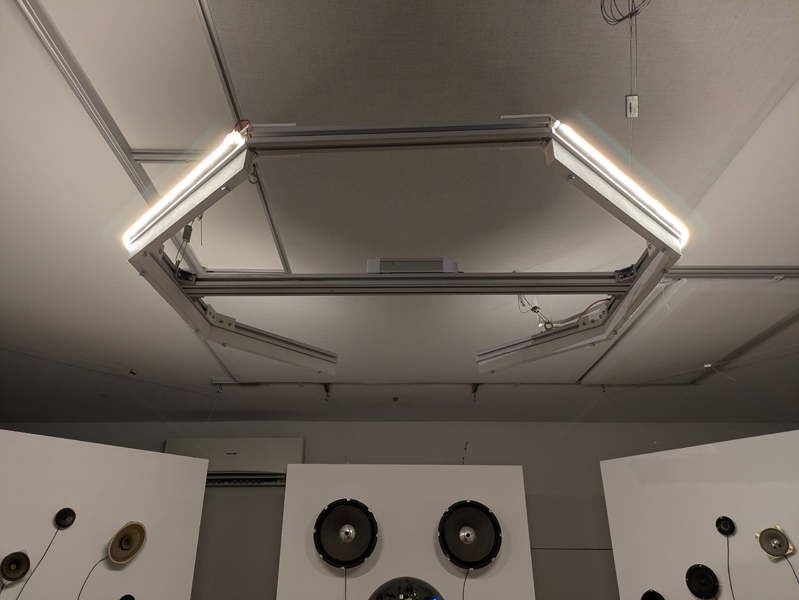
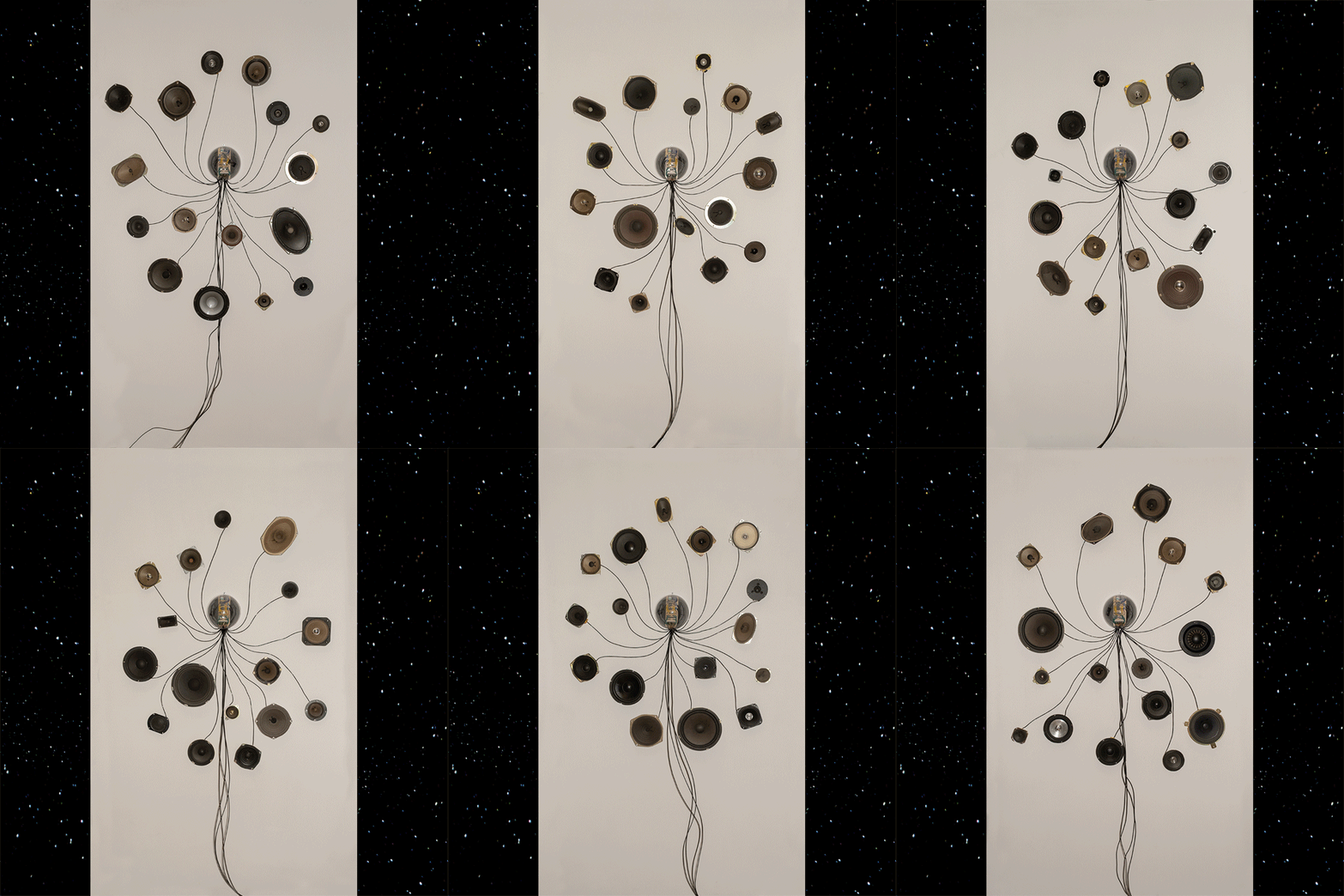
An octagonal space is formed by 7 large panels, the central one containing the brain and four speakers,
and the 6 others with sub-brains and 16 speakers. It is a non-interactive installation that
spatialises and changes the perception of sound. It is primarily a standalone sound installation,
but can also be used in a performative mode.
The starting point of this sound installation is that every speaker has its unique timbre.
Thus the same sound can be perceived differently depending on which one is playing the sound.
Due to the placement of the speakers as well as imperfections in the electronic switching and
amplification, the result is a bizarre lo-fi spatialisation.
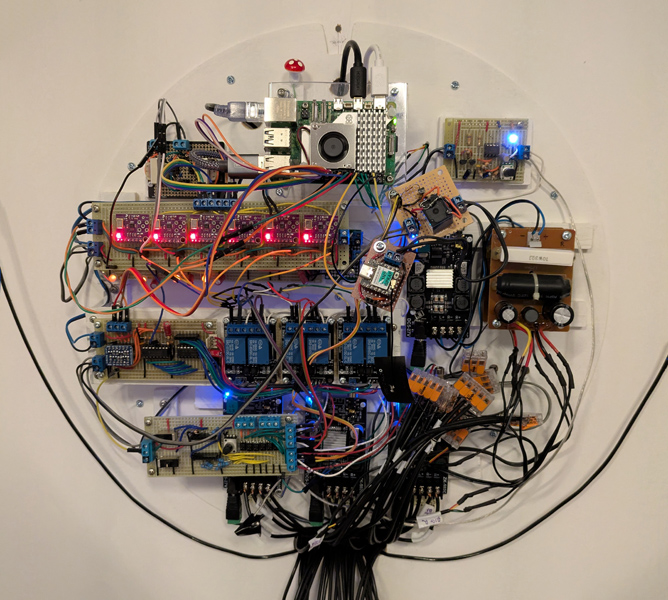
Six panels forming the octagonal listening space act as substrates where 100 speakers live. The brain is located on the seventh panel.
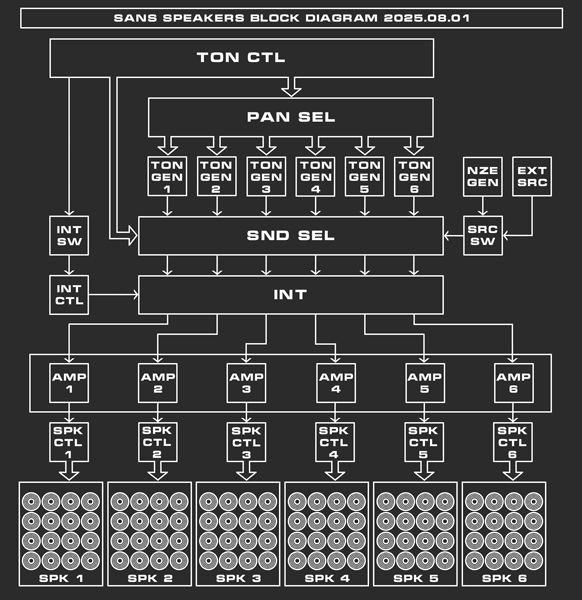
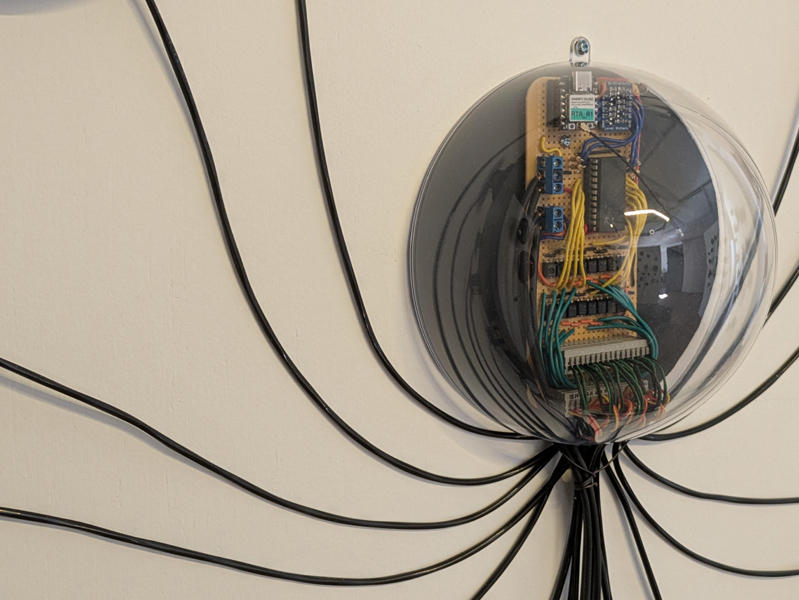
The panels are connected to the brain via filaments/wires. The brain decides what electronically generated sounds (simple triangle waves) will be
interpreted by each panel. A smaller independent brain on each panel decides which of its 16 connected speakers will produce sound at any given moment,
at its own ever-changing pace.
Each speaker filters the frequencies passing through it, effecting changes in timbre, texture, clarity, and colouration of the sound as it moves
from speaker to speaker around a panel.
The brain’s underlying behaviour is based on simple artificial lifeforms that live in a computer, known as
cellular automata.
The kind used in this piece are known as
turmites, which are 2-dimensional
Turing machines.
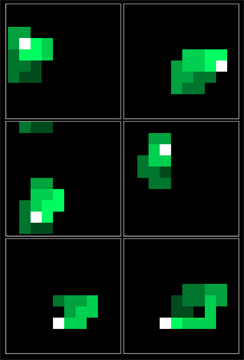
They move on a 10x10 matrix according to a simple set of rules.
Each cell of the matrix grid corresponds to a specific frequency/tone; the lowest frequency is at the top left, and rises, zig-zag fashion from left to right,
then the next row down, etc, until it reaches the highest frequency at the bottom right. Each speaker panel has its own turmite “world”, and the position of
the “ant” determines which tone is played on the panel. The ant leaves a behind a trail, visible as different shades of green, which influence the ant's movements,
and which fade with time. I've coined the term sonomones (sonic pheromones) for these trails. Diametrically opposed panels can also influence each other.
Due to imperfections in the system, the timing of switching, and the fact that no two speakers are alike, audible glitches, tonal shifts and differences
in timbre and volume are produced.
Here is an 80-second video showing the piece...
There are 3 main modes that the piece loops through:
Tur-mite mode: the cellular automata as described above.
Sequential mode: The ants, each at their own pace, are made to traverse their grids in an orderly fashion, going from left to right on each row,
and then upon reaching the last cell, reverse their direction. Thus, the tones played gradually rise in frequency and then descend.
White noise mode: Each panel is sent the same noise. (White noise combines all audible sound frequencies and sounds like hissing or rushing water or TV static.)
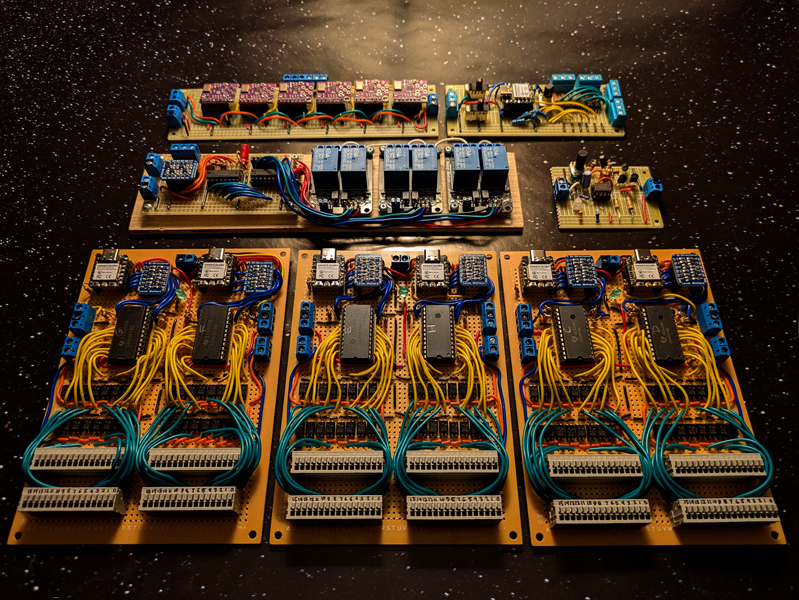
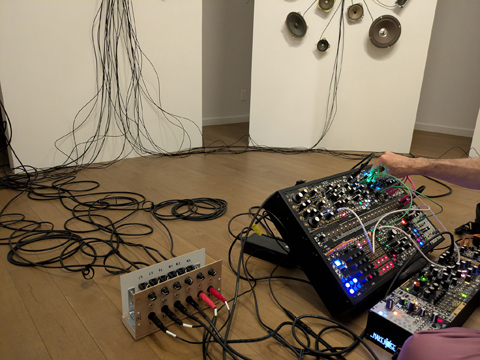
The main brain was driven by a Raspberry Pi 5 running a Python program. The speaker panel brains were driven by Xiao ESP32C3s (Originally, there was to be communication via MQTT, but in the end, the wireless function was not used). Visitors to the gallery had to reserve time slots to see the piece. According to this schedule, the gallery's system would turn on the lighting and power up the circuits, and when the door was opened, it sent an OSC message to the main brain so that it would start the visit script that would loop through the different modes. When the hour-long visit was over, things were automatically shut down, and the piece would go dormant until the next scheduled visit.
The hand-soldered custom circuits where controlled by the Raspberry Pi, although there was also a manual override to select a specific mode. Tones were generated by AD9833 waveform generator modules, and white noise by a simple transistor-based circuit. Various functions were handled by CMOS integrated circuits and electro-mechanical and solid state relays. The brains on each speaker panel used CMOS demultiplexers and solid state relays to handle the dispatching and switching of the audio to a specific speaker.
If you do the math, 6 panels with 16 speakers each gives 96, but the exhibition promises 100. The remaining 4 are found on the main brain panel, and are only active during a special brief mode wherein the tones from the closest panels are fed into a classic diode-based ring modulator and sent to the 4 speakers randomly using a
spatializer circuit. Just prior to this mode was another special brief mode wherein the tur-mites would move very rapidly (and thus the tones).
Tur-mites & Sound Simulation
Part of the original exhibition of the piece was a video screen in a darkened corner, where one can watch the cellular automata moving. With observation,
one can make a connection between the movement of the ants and the tones one can hear.
The main brain’s code has been converted to run on the web to illustrate the artificial life and the raw sounds that are sent to the speakers.
Here are two binaural recordings that document what it sounded like in the actual installation, best listened to on headphones.
Tur-mites mode audio excerpt:
White noise mode audio excerpt:
Concerts
The installation was designed so that the sound source can be switched from internal to external, i.e. that someone could plug in up to 6 channels of sound,
which would be sent to the corresponding panels. These sounds are then subject to the switching effects and the filtering through the different speakers,
over which the user has no control. This allowed exploration of sounds and effects other than what the exhibition was making.
During the exhibition at Eisode, two concerts were held. One featured Hélène Prévost, and the other featured Enfant magique (A.K.A. Eric Gingras).
Sans Speakers was exhibited at Eisode,
a space for generative arts in Ahuntsic (Montreal), from May 18th to July 5th, 2026.
A huge thank you to Eisode, artificiel, Line Nault and Alexandre Burton.
This piece was produced with financial help from the Conseil des arts et lettres du Québec (CALQ).
Special thanks to Fanny Arsenault-Villeneuve.
Thank you to the following people for their help, advice and support: David Lamarche, Marc Montanchez, Roberto di Giacomantonio, Austin Tecks-Bleuer, Clint Enns, Josée Brouillard, Tony Baraké, and Nicolay Kolish.
Photos by James Schidlowsky and William Normand-Robichaud.